
These seven principles have held up across two decades of web design evolution. They won't make your site trendy; they'll make it effective.
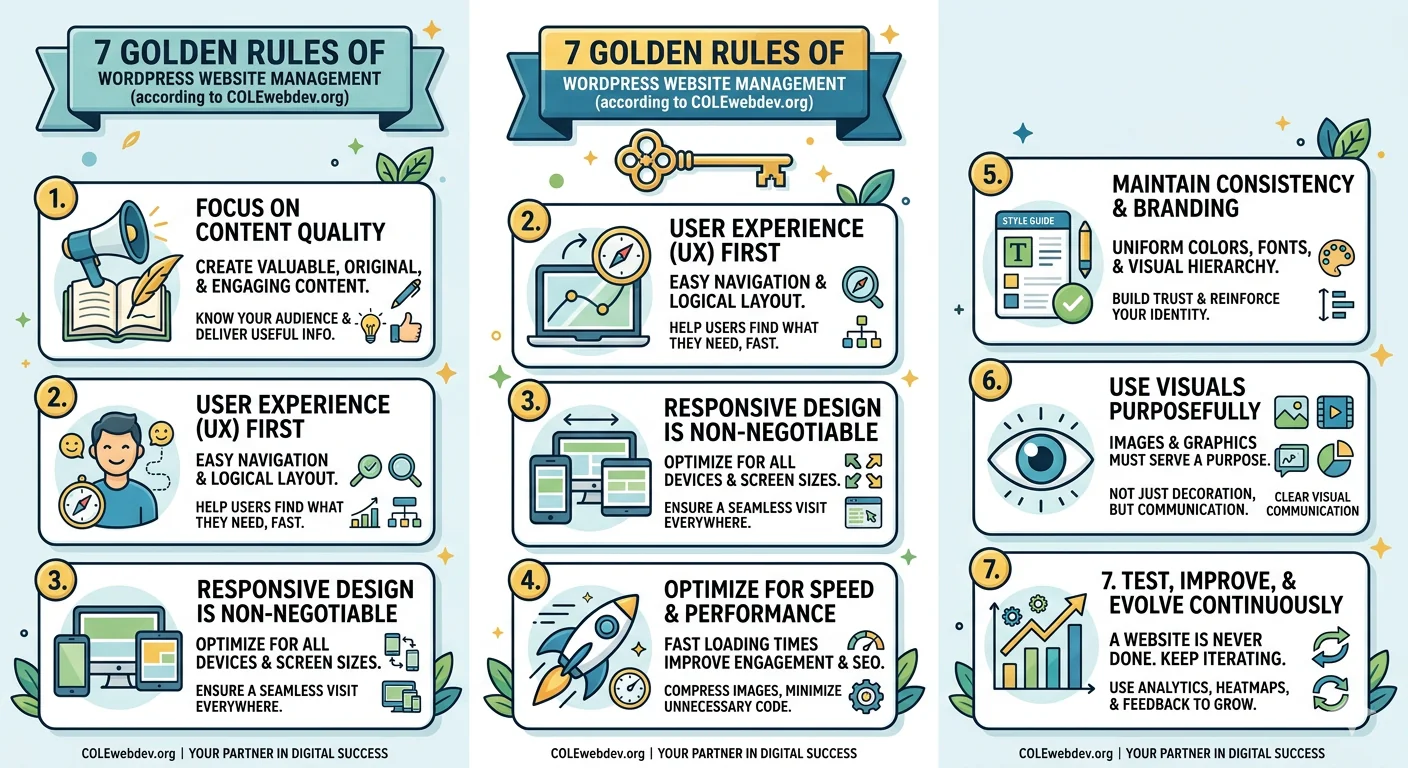
Rules 1–3: Simplicity, UX, and Consistency
Keep it simple. Every element on a page competes for attention. Too many options, too many visual layers, or too much text creates cognitive load that drives visitors away. Every element should earn its place by serving the user's goal or the business's goal. If it does neither, remove it.
Prioritize user experience. UX is the discipline of designing for how people actually behave, not how you'd like them to. Users scan, not read. They navigate non-linearly. They leave in seconds if they can't find what they're looking for. Be consistent. Predictable typography, color, and interaction patterns reduce the cognitive load of learning a site. Inconsistency reads as unprofessional and creates friction.
Rule 4: Mobile-First
Mobile-first means designing for the smallest screen before scaling up, not making a desktop site and hoping it works on phones. Most of your visitors are on their phones, especially if they found you through a local Google search. A site that doesn't work seamlessly on mobile loses more than half its potential customers before they read a single word.
Rules 5–6: Clear CTAs and Fast Load Speed
Every page should have one obvious next step: call, contact, buy, book. Multiple competing CTAs dilute attention. One primary action per page is enough. Make it prominent, make it clear, and don't bury it at the bottom.
Fast load speed is non-negotiable. A one-second delay in page response reduces conversions by 7%, according to Akamai. Heavy animations, large uncompressed images, and third-party scripts all add weight. Performance requires building only what's necessary, then testing the result.
Rule 7: Accessibility
An accessible website is usable by people with visual, auditory, motor, or cognitive disabilities. This means proper contrast ratios, keyboard navigation, alt text for images, and readable font sizes. Accessibility is also a legal consideration for businesses that qualify as "places of public accommodation" under the ADA.
As a practical side effect, accessible sites tend to rank better in search engines. The same practices that help screen readers navigate a site (clear headings, meaningful link text, semantic HTML) also help Google understand and index it.
The golden rules aren't constraints; they're a framework for making design decisions confidently. When in doubt, ask: does this make things simpler, clearer, faster, or more consistent?