
The real question isn't how much a website costs, it's how much revenue your current site is leaving on the table.
Reframing the Question
When small business owners ask "is web design expensive?", they're often asking the wrong question. The right question is: what is your current website costing you? A site that fails to convert visitors, doesn't rank in search results, or looks unprofessional on mobile is actively costing you business every day.
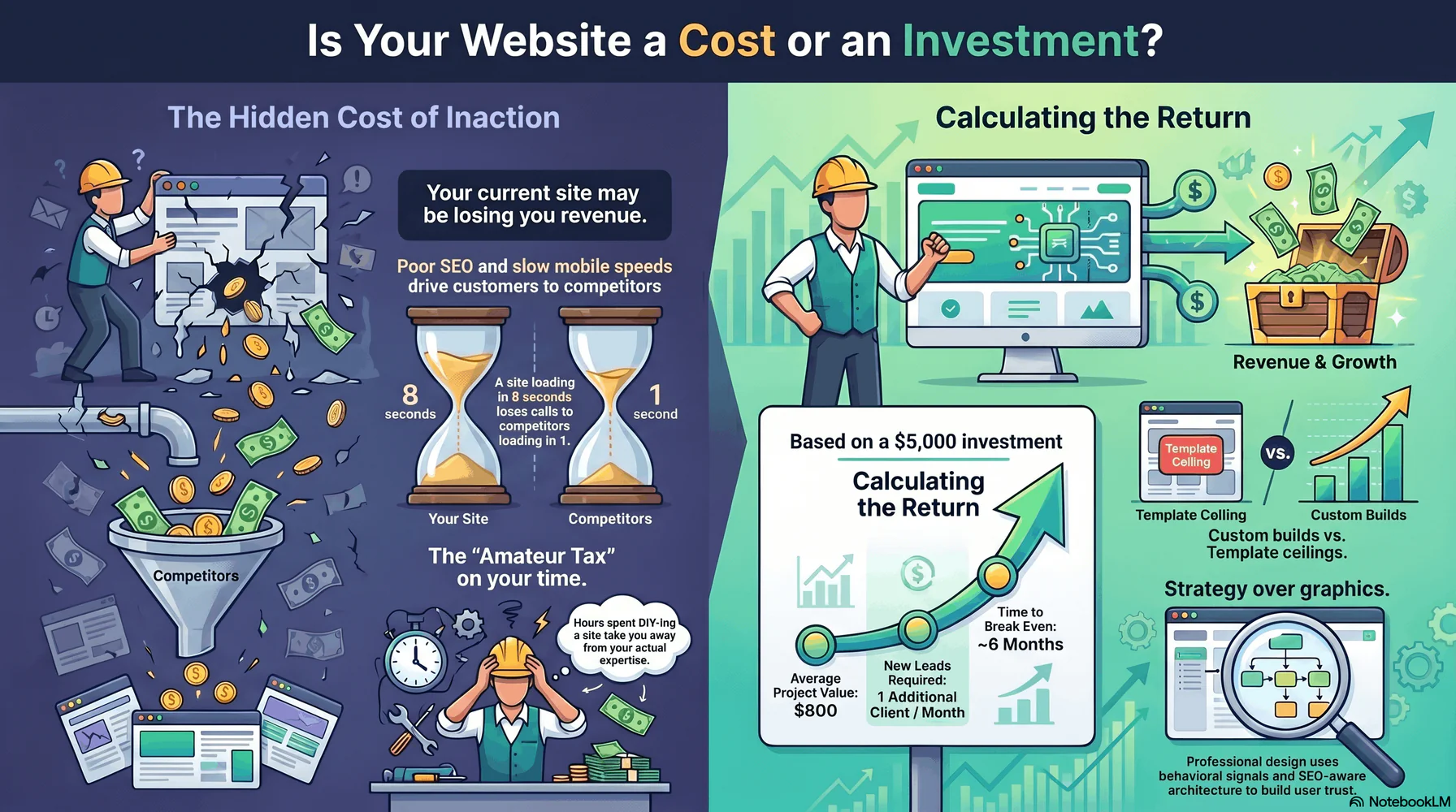
A plumber in Brewster whose website takes 8 seconds to load on a phone is losing calls to a competitor whose site loads in 1. A contractor in Falmouth with no Google presence is invisible to customers actively searching for their services. The cost of inaction is real, it's just invisible.
What You're Actually Paying For
A professional web design engagement includes more than code and graphics. You're paying for an experienced strategist who understands how users behave online, what signals build trust, and how to structure a site that aligns with your business goals. You're paying for SEO-aware architecture and mobile optimization that serves the majority of your visitors.
You're also paying for time savings. A business owner who builds their own website spends dozens of hours on something that isn't their expertise, and often ends up with a result that looks amateur and doesn't perform. That time has a cost too.
Custom vs. Template: The Real Trade-Off
Template-based platforms (Wix, Squarespace, GoDaddy) are useful for certain situations: early-stage businesses with minimal budget, or simple brochure sites with low traffic. They have real limitations: performance ceiling, SEO constraints, and the fact that every competitor can use the same template.
A custom-built site is architecturally optimized for your specific needs: no bloat, no generic structure, no compromises baked in. For a business that depends on its website to generate leads, the difference shows up in the numbers.
Thinking About Return on Investment
If a new website costs $5,000 and generates one additional client per month at an average project value of $800, it pays for itself in about 6 months. These aren't hypothetical numbers; they're the kinds of outcomes we've seen for COLEwebdev clients who moved from aging DIY sites to custom-built ones.
Think about what a single additional lead is worth to your business. Then ask whether a better website could realistically deliver one more per month. That's the right frame for the investment decision.
Treat web design as a revenue investment, not an expense. Calculate what a single additional customer is worth, then ask whether a better website could realistically deliver one more per month.